
 by
by 
Welcome back to our weekly roundup of happenings from XR and AI realms. Let’s dive in…
The Lede
Apple Inc. CEO Tim Cook will step down September 1, with hardware chief John Ternus taking over. Cook becomes executive chairman, keeping government relations. The market reaction was muted, the succession long expected and unanimously approved. The signal is the choice of an engineer. Apple is prioritizing hardware integration as the control point for AI, even while leaning on partners like Google for models. The strategy is to own the device layer where intelligence is delivered. Critics point to lagging AI spend, Siri delays, and leadership turnover. Apple has entered past platform shifts late and then set the standard through integration. Ternus helped deliver those products. Early judgment will hinge on Siri’s update at WWDC and any new devices he introduces.
Feeling Spatial
Tim Cook Only Half Solved Tech We Wear on Our Faces. Now It’s Ternus’ Turn. Apple has figured out a way to make AirPods work, and it even broke through an acceptance barrier of having our own faces be scanned as biometric authentication to unlock our phones. Vision Pro aside, one big product frontier still looms for Apple: Smart glasses. Can Apple give the product category its smart glasses’ moment? CNET’s Scott Stein explores possibilities
Where Will John Ternus Take Apple’s XR Road Map? With Ternus replacing Tim Cook as Apple CEO, the tech world is abuzz with speculation about the directions that he’ll take the iconic company. In the XR world, the focus is on the fate of Vision Pro and smart glasses road map.
XR device unit sales are projected to reach 50.68 million in 2030, according to ARtillery Intelligence’s latest figures. This factors in a projected inflection in 2027 as smart glasses blitz the market from Apple, Samsung, and others. Is the consumer market ready for this flood of faceworn devices, and how will this all materialize in the near term? Just because several new devices land in the market, it doesn’t guarantee that people will buy them.
Monkeys Navigate Virtual Worlds Using Brain Signals Alone. Researchers demonstrated that monkeys can navigate virtual environments using only neural activity, bypassing physical controllers. The study used implanted electrodes to translate brain signals into directional movement within a simulated space. Subjects learned to move through the environment and complete tasks using thought alone after training. The work builds on decades of brain-computer interface research focused on restoring motor function. The result shows improved precision and adaptability compared to earlier cursor control experiments. Applications include assistive technologies for paralysis and potential integration with immersive systems, though clinical deployment remains constrained by surgical requirements and long-term stability of implants.
The AI Desk
OpenAI Introduces ChatGPT Images 2.0. OpenAI released an updated image generation system integrated into ChatGPT, adding tools for iterative editing, inpainting, and multi-step image refinement within a single session. Users can modify specific regions of an image, adjust composition through follow-up prompts, and generate variations without restarting the workflow. The system operates inside ChatGPT rather than as a separate product. OpenAI states the update improves consistency across edits and better aligns generated images with user prompts. The release expands image generation capabilities already available in ChatGPT and continues OpenAI’s integration of multimodal tools into its core interface.
One of the results of this upgrade can be seen in the illustrations below, which were generated by ChatGPT. When queried on their origin, ChatGPT said: “Those visuals are generated by querying an image index and surfacing generic, representative results based on the topic. They are not selected from a specific article, publication, or photographer, and they are not tied to a verified source or rights-cleared asset. They function as visual placeholders. If you plan to publish, treat them as unlicensed stock style imagery. For anything that requires rights certainty, you would need to source images directly from a licensed provider or the original publisher.”
Robot Race
Humanoid Robots Beat Humans in Beijing Half Marathon. Dozens of humanoid robots competed alongside more than 12,000 human runners in Beijing’s E Town half-marathon, running on parallel courses. The top robot, developed by Chinese smartphone maker Honor, finished the 21-kilometer race in 50 minutes and 26 seconds, faster than the human world record. Nearly half of the robots navigated autonomously, a shift from last year when most required remote control. Participation expanded from about 20 teams in 2025 to more than 100 this year.
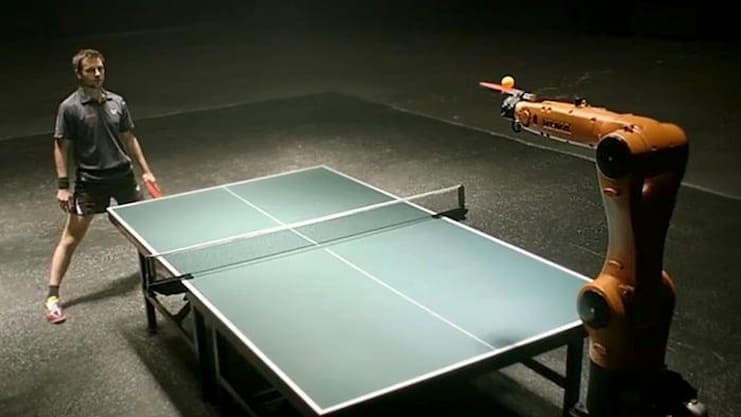
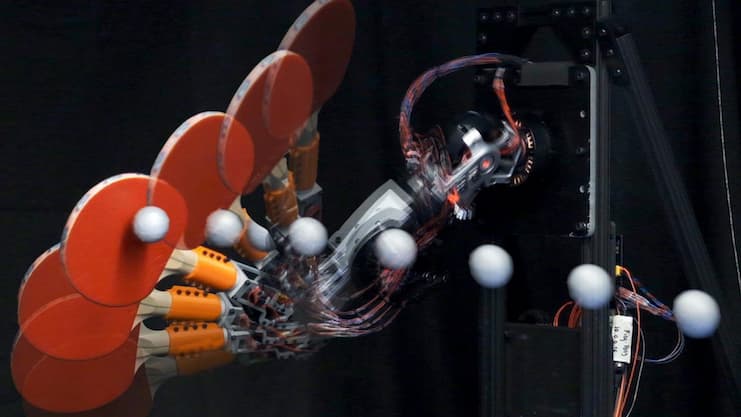
AI Robot Defeats Elite Table Tennis Players. A robotics system using AI vision and control algorithms defeated elite human table tennis players, marking progress in real-time physical interaction tasks. The system combines high-speed cameras, predictive modeling, and robotic actuation to track and return shots with competitive accuracy. Table tennis presents challenges including rapid motion, spin detection, and continuous adaptation. Researchers report performance at a level capable of sustained rallies and point scoring against advanced players. The milestone reflects broader advances in embodied AI, where systems operate in dynamic physical environments. Potential applications extend to manufacturing, training systems, and human-robot collaboration requiring fast reflexive responses.
Cinematic Corner
Watch the last three episodes of Linda’s Last Podcast below. Produced by the author of this column, you can see the series archive and subscribe on YouTube.
Spatial Audio
This column has a companion, the AI/XR Podcast, hosted by its author, Charlie Fink, and Ted Schilowitz, former studio executive and futurist for Paramount and Fox, and Rony Abovitz, founder of Magic Leap and Synthbee AI.
Our latest guest was Alan Lasky, visual effects supervisor (his credits include The Mandalorian), studio executive, and futurist (see episode below). Our next guest will be Akash Nigram, founder and CEO of Genies, which makes AI avatars of celebrities and sports stars that you can talk to today.
Episodes drop on Tuesdays, and you can find them on podcasting platforms Spotify, iTunes, and YouTube.
 Charlie Fink is an author and futurist focused on spatial computing. See his books here. Spatial Beats contains insights and inputs from Fink’s collaborators, including Paramount Pictures futurist Ted Shilowitz.